
If there’s one thing every couple agrees on, it’s this — wedding budgets are confusing.
You start with a number that feels generous. Then quotes come in. Then guest lists grow. Then someone mentions a tasting, a trial, a setup fee, a service charge — and suddenly the spreadsheet you were so proud of looks completely different.
Sound familiar?
The truth is, most couples in the UK don’t overspend because they’re reckless. They overspend because no one tells them where the money actually goes until they’re already deep into the planning process.
So let’s fix that.
This is a real, honest breakdown of where your wedding budget goes in 2026 — what costs what, what’s worth investing in, and where smart couples are quietly saving thousands without compromising the day.
Why Wedding Budgets Feel Out of Control in 2026
Before we get into numbers, it helps to understand why budgets are tighter than ever this year.
A few things have shifted:
Venue prices in the UK have steadily climbed
Catering costs per head have risen across the board
Suppliers are booked further in advance — meaning less room to negotiate
Couples are expecting a more “experience-led” wedding, which adds layers most older budgets didn’t include
It’s not that weddings are getting unreasonable.
It’s that the way couples want to celebrate has evolved — and the budget needs to evolve with it.
The Average UK Wedding Budget in 2026 (And Why Averages Are Misleading)
You’ll see figures online ranging from £20,000 to £40,000 for a “typical” UK wedding.
For Asian weddings — especially multi-day celebrations with larger guest lists — that figure can comfortably climb to £60,000, £80,000, or beyond.
But here’s the thing about averages: they don’t tell you the story behind the spend.
A £30,000 wedding done well can outshine a £70,000 wedding done badly.
What matters isn’t the total — it’s how the money is distributed.
The Smart Budget Split: Where Your Money Should Actually Go
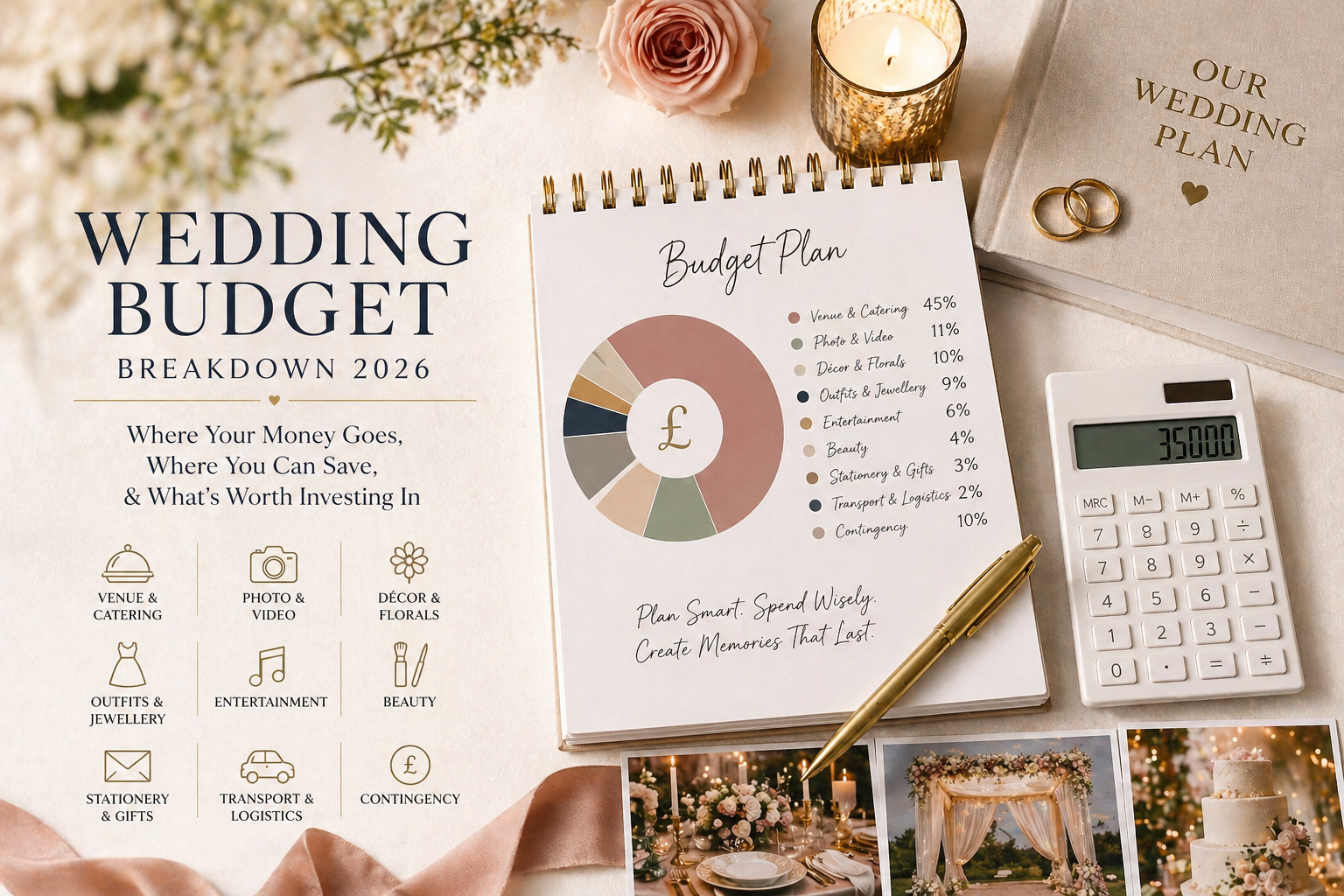
Here’s a realistic breakdown most experienced wedding planners would agree on for a UK wedding in 2026.
CategoryTypical % of Total BudgetVenue & catering40 – 50%Photography & videography10 – 12%Décor, florals & styling8 – 12%Outfits & jewellery8 – 10%Entertainment (DJ, live music, performers)5 – 8%Hair, makeup & beauty3 – 5%Invitations, stationery & gifts2 – 4%Transport & logistics2 – 3%Contingency (the one most couples skip)5 – 10%
Notice that last line?
That contingency buffer is what separates a stressed couple from a calm one — and almost no one budgets for it until it’s too late.
Where Most Couples Quietly Overspend
After speaking with suppliers across IDD’s network and watching couples plan year after year, the same overspending patterns show up again and again.
1. The Venue Trap
Couples fall in love with a venue before they’ve checked what’s actually included.
Ask early:
Is corkage charged?
Is there a minimum spend?
Are chairs, linens, and basic décor included?
What’s the overtime rate?
A “cheaper” venue with hidden fees often ends up more expensive than a transparent one.
2. Décor That Looks Bigger on Paper
Décor quotes can balloon fast — especially when couples keep adding “small” extras.
A floral arch here.
An aisle runner there.
An upgraded centrepiece for the top table.
Individually, they feel minor. Together, they can add £3,000 – £5,000 you didn’t plan for.
3. Outfit Add-Ons
Bridal and groom outfits rarely stay at their original quote. Alterations, accessories, second outfits, jewellery, and final touches almost always push the total higher than expected.
4. Last-Minute Bookings
Booking late means paying premium rates — and being left with whatever’s available, not what you actually want.
Where Smart Couples Are Saving in 2026
Now for the more useful side of the conversation.
These are the areas where couples are confidently saving — without their wedding feeling “cheaper” in any way.
1. Choosing Suppliers Through Curated Networks Instead of Random Searches
Couples are realising that scrolling Instagram or Google for hours rarely delivers the right match.
Curated platforms like InDetail Directory narrow down suppliers who are vetted, professional, and aligned with the kind of wedding you actually want — saving time and avoiding costly mistakes.
2. Booking Off-Peak Dates
Friday and Sunday weddings, off-season months, or non-bank-holiday weekends can save couples 10 – 25% on venue and supplier costs.
The day looks identical.
The bill doesn’t.
3. Bundling Suppliers Where It Makes Sense
Some venues offer in-house catering or décor packages that genuinely save money.
Some photographers and videographers work as a team and offer combined rates.
Some MUAs travel with hair stylists for a discounted package.
The trick is knowing which bundles are real value — and which are just clever marketing.
4. Asking the Right Questions Before Booking
Most overspend happens because the wrong question wasn’t asked at the start.
A few that always pay off:
What’s included vs what’s extra?
What’s your cancellation and rescheduling policy?
What does the final invoice typically look like compared to the initial quote?
Are there any costs that come up later that couples often miss?
A good supplier will answer these without hesitation.
A vague answer is your warning sign.
The Categories Worth Spending More On (Honestly)
Not every line item deserves the same treatment.
If your budget is tight and you’re wondering where to invest, these are the areas that genuinely shape how your wedding looks, feels, and is remembered.
1. Photography & Videography
Long after the cake is gone and the décor is packed away, your photos and films are what remain.
This is one of the few categories where “cheap” almost always shows up later — in missed moments, poor lighting, or visuals that don’t age well.
2. The Venue
The venue sets the tone for everything else.
A beautiful venue needs less décor. A poor venue needs heavy styling to compensate. Spending well here often saves you elsewhere.
3. Catering
Guests forget the centrepieces.
They never forget the food.
A wedding remembered for great food is a wedding remembered well.
4. A Trusted Planner or Coordinator (Even Just for the Day)
Even if you’re planning the wedding yourself, hiring a coordinator for the wedding day alone can be one of the highest-value decisions you make.
It’s the difference between watching your wedding happen — and stressing through it.
Categories Where You Can Comfortably Scale Back
There are areas where smart couples consistently spend less without anyone noticing.
Favours — most guests don’t take them home
Over-the-top stationery suites — digital invitations are increasingly accepted
Excessive florals on tables guests barely sit at
Multiple outfit changes beyond what feels meaningful to you
Premium upgrades on items guests won’t see or remember
Spend on what people experience.
Save on what people forget.
The Hidden Cost No One Talks About: Decision Fatigue
Here’s something rarely included in budget breakdowns — the cost of indecision.
Couples who keep second-guessing suppliers, comparing endlessly, and chasing better quotes often end up:
Paying premium rates for late bookings
Locking in suppliers they didn’t fully vet
Losing deposits on suppliers they switched away from
Spending on emergency fixes when things fall through
The financial impact of decision fatigue is real — and it’s why working from a curated, trusted network of suppliers from the start saves more than money. It saves momentum.
How IDD Helps You Plan Smarter — Not Just Bigger
InDetail Directory was built around a simple idea:
Couples shouldn’t have to gamble on suppliers, chase down quotes, or guess who they can trust.
By bringing together vetted UK wedding suppliers — across photography, catering, décor, entertainment, fashion, beauty, venues, and more — IDD makes it easier to:
Find suppliers who actually match your wedding style
Compare options without the social media noise
Request Quick Quotes in one place instead of dozens of inboxes
Discover trusted vendors you wouldn’t have found through Google alone
Smart planning isn’t about cutting corners.
It’s about making confident decisions with the right information.
A Quick Wedding Budget Sanity Check
Before you finalise anything, run through this short checklist:
Have you set aside 5 – 10% as a contingency?
Have you confirmed what each supplier’s quote actually includes?
Do you know which categories you’re intentionally investing in?
Have you booked your top three priorities first?
Have you avoided spending on things only you (and not your guests) will notice?
If you can answer “yes” to most of these, your budget is in a far healthier place than most couples’ are six months in.
Final Thoughts
A wedding budget isn’t about restriction.
It’s about clarity.
When you know where the money goes, what’s worth spending on, and where you can comfortably hold back — planning stops feeling overwhelming and starts feeling intentional.
The couples who plan the most beautiful weddings in 2026 won’t necessarily be the ones with the biggest budgets.
They’ll be the ones who spent with purpose.
And that’s what IDD is here to help you do — connect you to the right suppliers, at the right time, for the right reasons.
Because the most memorable weddings aren’t the most expensive ones.
They’re the ones that feel like you.












Leave A Comment
You must be logged in to post a comment.